Jul 20, 2026Buying Guides
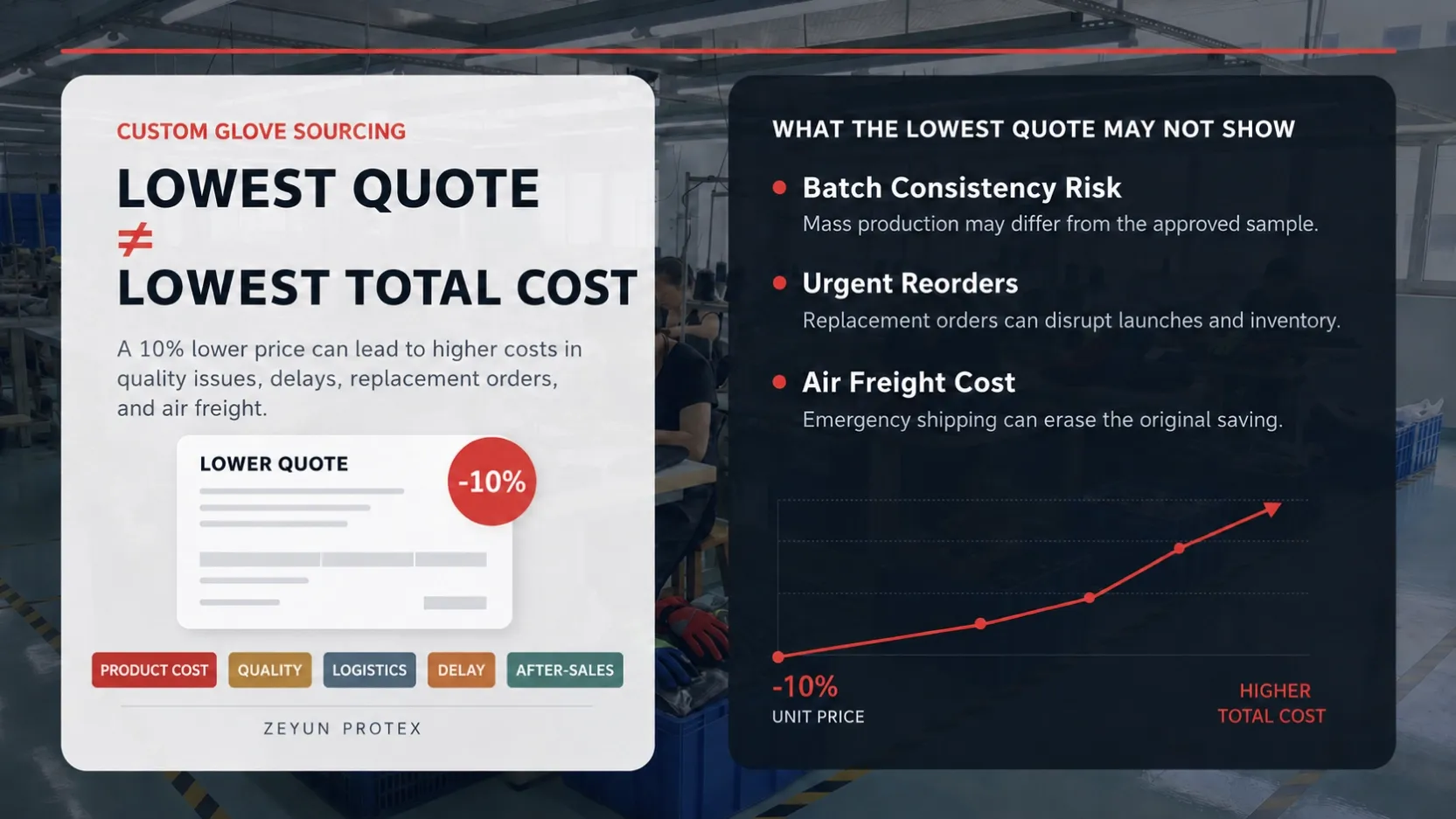
How to Choose a Custom Glove Supplier: Why a Buyer Who Saved 10% with a Lower-Cost Supplier Came Back Six Months Later
How to Choose a Custom Glove Supplier: Why a Buyer Who Saved 10% with a Lower-Cost Supplier Came Back Six Months Later
After years of working on custom glove OEM projects, we have noticed an interesting pattern.
Buyers who care only about price usually do not spend much time negotiating back and forth. They collect quotations, compare numbers, and make a decision quickly.
The more complicated situation is when a buyer recognizes a supplier’s product development capability, sample quality, and technical expertise—but still chooses another custom glove supplier because the quote is 10% lower.
We once had a customer who made exactly that decision. Six months later, they came back.
A Custom Glove Order That Came Down to a 10% Price Difference
The customer was serving the European and North American markets and was looking for an OEM supplier for a sports glove project.
From the first product discussion to sample approval, the development process took nearly a month.
We adjusted the construction based on the customer’s product positioning, recommended suitable materials, and revised the fit and design details several times.
The customer was satisfied with the samples and generally recognized our product development capabilities.
The disagreement came at the quotation stage.
The customer felt our price was too high and asked us to reduce it further.
After recalculating the material costs, production processes, and order quantity, we adjusted the price by about 2%. That was essentially the maximum reduction we could make without changing the main materials or manufacturing standards.
The customer then told us that another supplier had quoted about 10% less.
In the end, they chose the lower-priced supplier.
At the time, we explained that the price difference could come from material grades, manufacturing methods, quality control, or mass-production consistency.
But when a purchasing decision is reduced to one clear number, those invisible differences are difficult to prove in advance.
A 10% saving is easy to calculate.
Quality risk, delivery risk, and batch consistency are much harder to put on a quotation sheet.
We lost the order.
Six Months Later, the Customer Contacted Us Again
About six months later, the customer suddenly reached out.
This time, the situation was urgent.
The gloves they had purchased had already arrived at their local warehouse and were preparing to enter the sales channel. However, there were consistency issues across the production batches, and part of the shipment could not be sold as originally planned.
The customer needed to reorder a replacement batch within a very tight time frame.
We reconfirmed the product specifications, materials, and production schedule, then compressed the lead time as much as possible.
To meet the original retail launch window, the entire replacement shipment was eventually sent by air.
The additional air freight cost alone was already significantly higher than the 10% they had originally tried to save on the purchase price.
That did not include the cost of additional communication, warehousing, quality handling, replacement production, or delayed sales.
After that project, the customer resumed regular orders with us.
Price discussions also became much more straightforward.
We still work together today.
During one conversation, the customer joked:
“That shipment taught me a lesson I’ll remember for years.”
The Lowest Quote Does Not Always Mean the Lowest Purchasing Cost
When sourcing custom gloves, the easiest number to compare is the unit price.
But unit price is not the same as the true cost of a project.
A more useful purchasing concept is Total Cost of Ownership, or TCO.
For an OEM glove project, total cost can be simplified as:
Total Cost = Product Cost + Quality Failure Cost + Logistics Cost + Delay Cost + After-Sales Cost
When mass production goes wrong, the additional costs may include:
- Rework, remanufacturing, or replacement orders
- Warehousing, returns, and after-sales handling
- Emergency replenishment and air freight
- Missed product launches or peak selling seasons
- Distributor, retailer, or end-user complaints
That is why:
The lowest quotation does not always result in the lowest total purchasing cost.
A better question is:
Which supplier can keep the project’s total cost and risk under control while still meeting your product positioning, quality expectations, and delivery schedule?
Why Can Two Glove Suppliers Quote Different Prices?
A lower price does not automatically mean a supplier is poor.
Every factory has a different market position, supply chain structure, production model, and cost base.
The important question for the buyer is:
Where is the cost difference coming from?
1. Different Material Grades
A specification sheet may list the same general materials:
- Genuine leather
- Microfiber
- PU
- Waterproof membrane
- Thermal insulation
But the same material name does not mean the same material quality.
Differences may exist in thickness, weight, abrasion resistance, hand feel, finish, and batch-to-batch consistency.
So instead of asking only:
“Are you using microfiber?”
A better question is:
“What specification of microfiber are you using, and can you maintain the same material in mass production as in the approved sample?”
2. Different Manufacturing Processes
Many manufacturing differences are not obvious when a glove is brand new.
They become visible after repeated use.
For example:
- Are high-stress areas properly reinforced?
- Is the stitch density appropriate?
- Are adhesive and bonding processes stable?
- Are the thumb crotch, finger seams, and palm areas designed for durability?
These details may never appear as separate line items on a quotation, but they can significantly affect product life.
3. Different Quality Control Standards
The important question is not whether a supplier “has QC.”
Almost every supplier will say:
“We have strict quality control.”
A better question is:
What do you inspect? What standards do you inspect against? What happens when defective products are found?
Clear incoming inspection, in-process inspection, and final inspection procedures make production consistency easier to control.
Low price itself is not the biggest risk. Unpredictable quality is.
4. Different Mass-Production Consistency
A good sample proves that a supplier can make the product once.
The real manufacturing challenge is:
Can the supplier reproduce that approved sample consistently across thousands or tens of thousands of pairs?
If materials, trims, or production methods change frequently during mass production, the final shipment may vary significantly even when the original sample was excellent.
For an OEM glove manufacturer, sample development is only the beginning.
Stable replication at scale is what truly demonstrates manufacturing capability.
5. Different Problem-Solving Capabilities
Good service is not simply about replying to messages quickly.
A valuable manufacturing partner should be able to:
- Identify risks during product development
- Say “we do not recommend this” when a design creates unnecessary risk
- Report production issues early
- Focus on solving problems instead of avoiding responsibility
In custom product development, knowing what can be done, what cannot be done, and what should not be done is part of a supplier’s technical value.
Similar Product Specifications Do Not Guarantee the Same Final Product
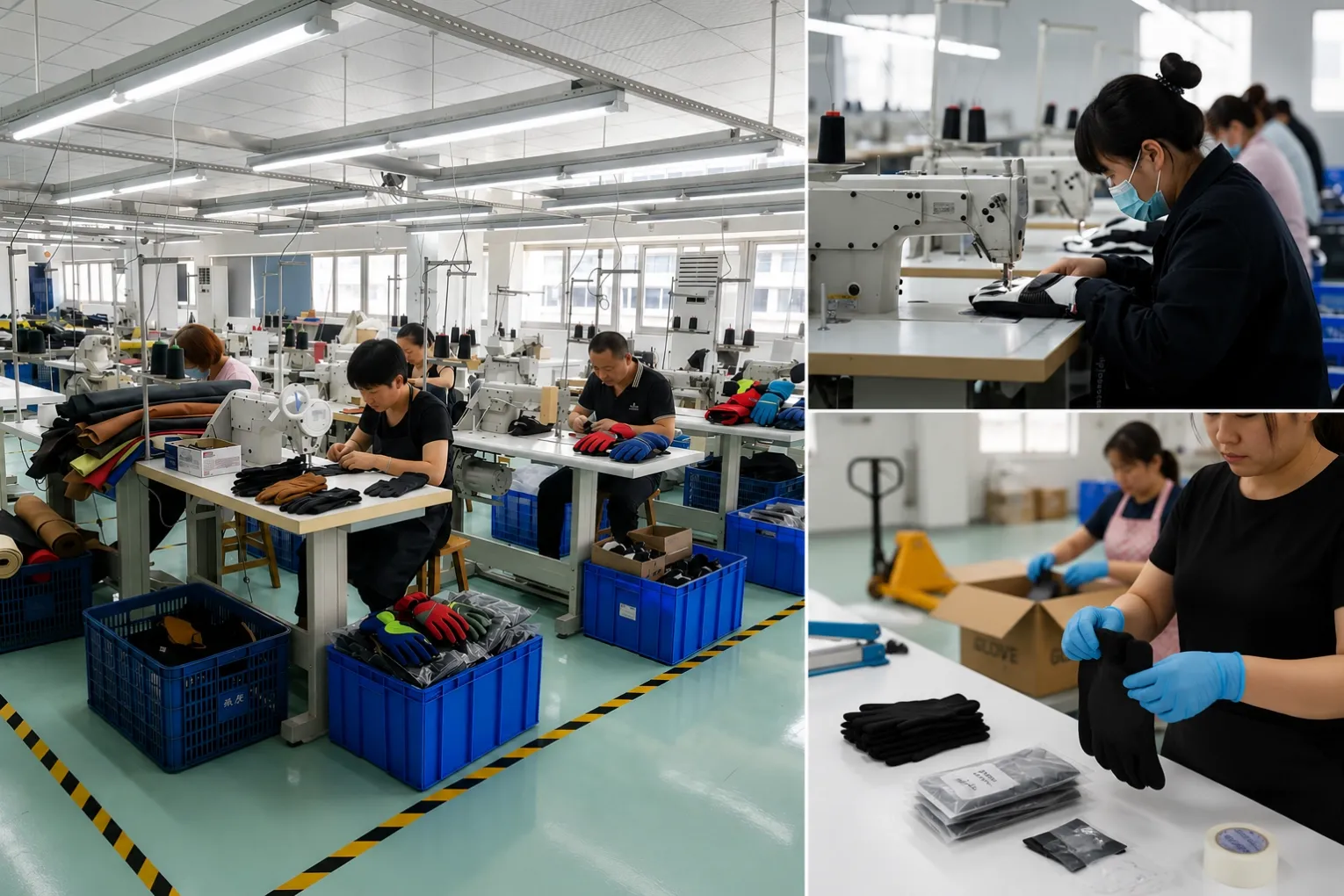
A common mistake in OEM sourcing is assuming that two suppliers will produce the same product simply because their BOMs and specification sheets look similar.
That is rarely the case.
Two specifications may both list:
- Microfiber palm
- Polyester back
- Reinforced stitching
- Custom logo
Yet the final products can still differ because of:
- Material grade and thickness
- Pattern and fit
- Stitch density
- Thread tension
- Reinforcement construction
- Logo application quality
- Mass-production quality control
In other words:
A specification sheet tells you what materials are used. Manufacturing capability determines what those materials become.
The same BOM does not guarantee the same finished product.
7 Questions to Ask When Choosing a Custom Glove Supplier
1. Are the Material Specifications Clear Enough?
Do not confirm only the material name.
Where relevant, clarify:
- Material type
- Thickness
- Weight
- Performance requirements
- Color requirements
- Supply consistency
The more vague the material description, the more room there is for variation during mass production.
2. How Will Sample-to-Production Consistency Be Controlled?
Confirm whether:
- The supplier retains the approved sample
- Mass production follows the approved sample
- Key materials are locked before production
- Material changes require customer approval
A good sample proves that a supplier can make the product. Stable mass production proves that they can keep making it consistently.
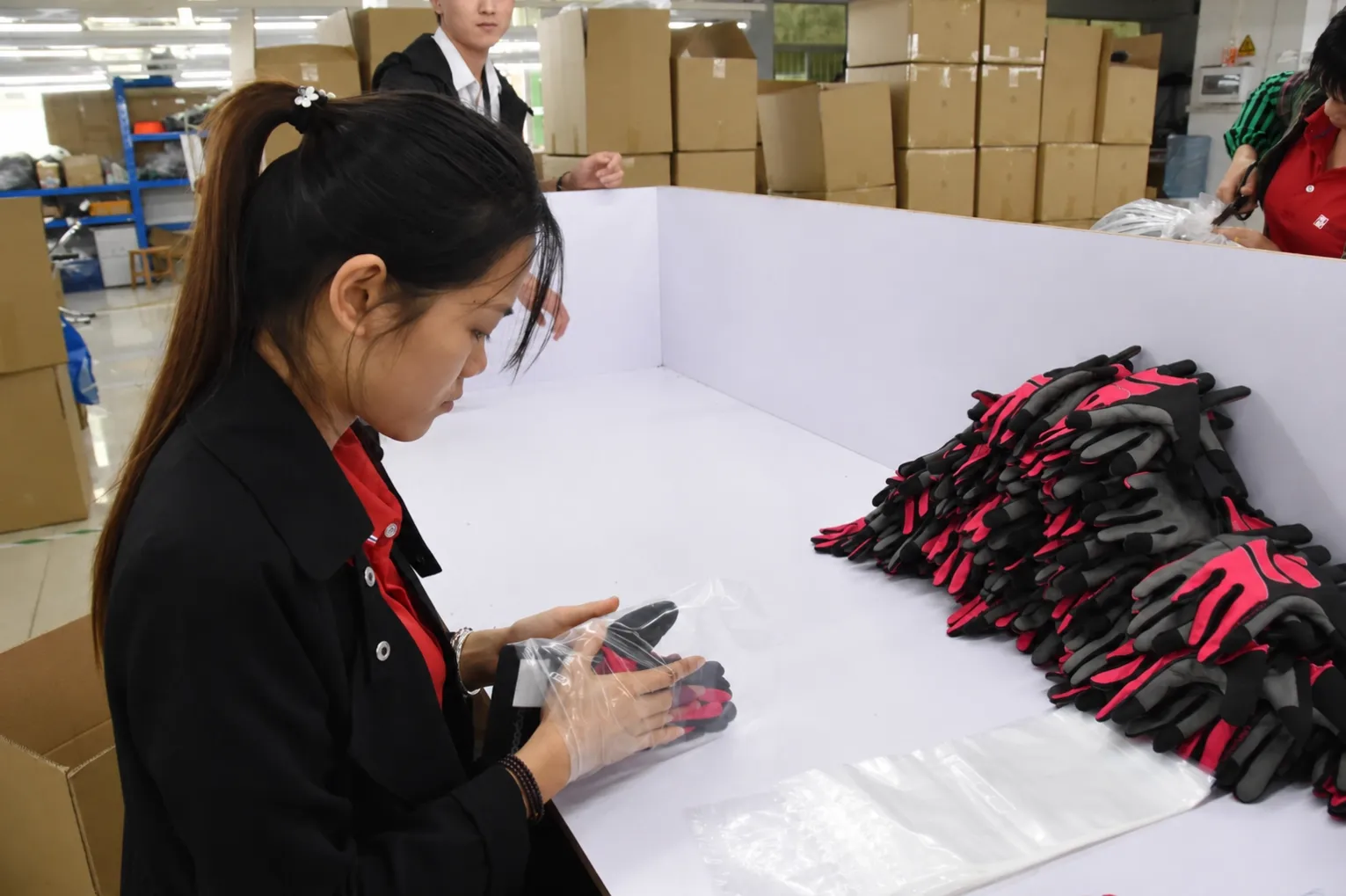
3. Are Critical Manufacturing Processes Clearly Defined?
Pay particular attention to areas that affect durability and performance, such as:
- High-stress zones
- Stitching
- Reinforcement
- Logo application
- Hook-and-loop closures
- Waterproof construction
The more critical the construction detail, the less it should depend on verbal understanding alone.
4. How Is Quality Control Actually Performed?
Do not stop at asking:
“Do you have QC?”
Ask:
“What do you inspect during production and before shipment?”
The clearer the inspection criteria, the easier it is for both buyer and supplier to work toward the same quality standard.
5. Is the Supplier Willing to Tell You When an Idea Is Not Recommended?
A professional supplier should not answer every request with:
“Yes, no problem.”
They should be able to explain:
- Why a design may create risk
- What problems could occur
- Whether a better alternative exists
Sometimes, a supplier that is willing to say “we do not recommend this” is more trustworthy than one that agrees to everything.
6. How Does the Supplier Respond When Problems Occur?
No manufacturer can realistically promise that problems will never happen.
The real difference is what happens next:
Does the situation spiral out of control, or is it identified and contained quickly?
Even during early communication, you can often tell whether a supplier avoids difficult issues, actively investigates root causes, and is willing to propose practical solutions.
7. Can the Supplier Explain the Price Difference?
A mature supplier should be able to explain:
- Which costs come from materials
- Which costs come from manufacturing processes
- Where costs can be optimized
- Where cost-cutting may create unnecessary risk
The best supplier is not necessarily the one with the lowest quotation.
A better supplier helps the buyer understand:
Where money is worth spending, where costs can be reduced, and where short-term savings are not worth the risk.
Our Approach to Pricing: Not Always the Cheapest, but Clear About Where the Cost Goes
We know that ZEYUN PROTEX is not always the lowest-priced custom glove supplier in the market.
That does not mean “more expensive is always better.”
In many OEM and private-label projects, we actively help customers reduce unnecessary costs.
- Some designs can be simplified.
- Some materials can be replaced with alternatives that offer similar performance at a more practical cost.
- Some packaging does not need to be overly complicated.
- Some product features add cost without creating meaningful value for the end user.
Those are costs worth optimizing.
But when it comes to critical materials, essential reinforcement, key manufacturing processes, and necessary quality control, we generally do not recommend saving a small amount per pair if it introduces disproportionate product risk.
Instead of simply asking:
“Can you make it cheaper?”
We prefer to discuss:
“Where can we reduce cost without creating unnecessary product risk?”
That is a very different purchasing question.
FAQ: Choosing a Custom Glove Supplier
Q1: How Important Should Price Be When Choosing a Custom Glove Supplier?
Price matters, but it should not be the only selection criterion.
Buyers should also evaluate product consistency, material stability, sampling capability, mass-production control, lead time, communication, and problem-solving capability.
A lower unit price does not necessarily mean a lower total project cost.
Q2: Why Can Two Glove Suppliers Using Similar Materials Have Very Different Prices?
Because a material name is only part of the specification.
Two suppliers may both list “microfiber,” “leather,” or “polyester,” while the actual materials differ in grade, thickness, weight, abrasion resistance, and supply consistency.
Construction complexity, manufacturing processes, order quantity, production loss rates, quality control, and packaging requirements can also affect the final quotation.
Q3: How Can I Tell Whether an OEM Glove Sample Represents Mass-Production Quality?
Focus on three areas:
- Whether the approved sample is retained and used as the production reference
- Whether key materials and trims are locked before mass production
- Whether in-process and pre-shipment inspections are clearly defined
For a new supplier, a small trial order can also help verify production consistency before scaling up.
Q4: What Is the Biggest Risk of Choosing a Low-Cost Glove Supplier?
The biggest risk is usually not the low price itself.
It is unpredictability.
A supplier with efficient operations and a strong cost structure may legitimately offer a lower price while maintaining stable quality.
The real warning sign is when a supplier cannot clearly explain why the price is lower—or cannot demonstrate that the same quality can be maintained in mass production.
Q5: What Information Should I Confirm When Evaluating a Sports Glove OEM Supplier?
Depending on the project, buyers should normally confirm:
- Product specification
- Material specification
- Size specification
- Approved sample
- Logo and artwork confirmation
- Packaging specification
- Quality criteria
- Production timeline
The clearer these details are before production, the lower the risk of misunderstandings between sampling, mass production, and final delivery.
Conclusion: Low Price Is Not the Problem. Not Knowing What Was Removed to Achieve It Is.
That customer later told us that the experience changed the way they thought about supplier selection.
It reinforced something we have also learned through years of OEM manufacturing:
The lowest quotation does not always mean the lowest purchasing cost.
This does not mean buyers should always choose the more expensive supplier.
A professional custom glove supplier should also help customers control costs.
But smart cost optimization starts by asking the right questions:
- Which costs can be reduced safely?
- Which design features can be simplified?
- Which materials can be substituted without affecting the product’s intended performance?
- Which critical processes are not worth compromising?
But when it comes to materials, manufacturing processes, quality standards, and quotation structure, we believe customers should understand what they are paying for and why it matters.
When evaluating a sports glove OEM, private-label, or other custom glove project, the better question is not simply how to get the lowest price.
It is:
Where can costs be optimized—and where is the risk simply not worth taking?
Planning a Custom Glove Project?
Choosing the right supplier is not only about finding the lowest unit price. It is about finding the right balance between cost, quality, production consistency, and supply reliability.
If you are developing a sports glove, private-label glove, or other custom glove project, share your product specifications, target market, expected order quantity, and budget with us.
The team at ZEYUN PROTEX can help you review the project from a manufacturing perspective—where costs can be optimized, which specifications need closer attention, and where cutting costs may create unnecessary risk.
Contact us to discuss your next custom glove project and build a more reliable path from sample to mass production.